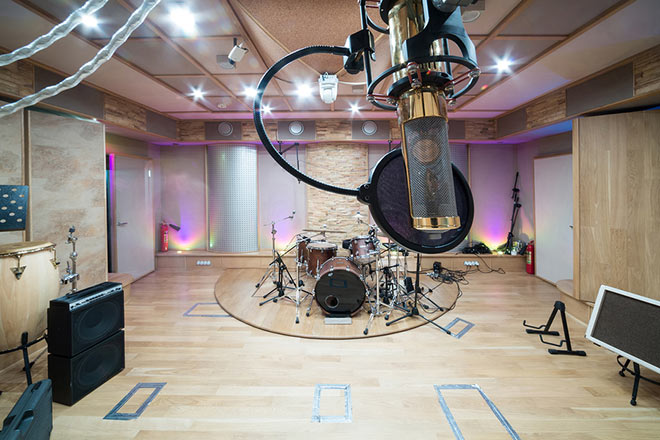
This article is the first in a two part series of detailed tutorials on how to mix drums in a studio recording . For the full info how to prepare for a good drum mix read on….
Before Mixing
After Mixing
We’ll assume that you already know how to tune a drum kit and that you’ve already mastered the basic mic placement techniques used for most drum recordings. If you’re totally new to recording live drums, read our other article ‘How to Record Drums‘ from our sister site Platinumloops.
How to Mix Drums – Choose Your Drums Wisely
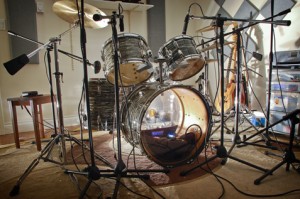 Over the last 15 years we’ve recorded a lot of live drum sessions and it never ceases to amaze us just how unique certain drums can sound. Take for example the sessions we did for Ska Drum Loops V1 which used a vintage Ludwig kit.
The snare drum that we used was a Supraphonic which had one of the most distinctive and powerful sounds we’ve ever heard. It was also extremely loud which suited the needs of the sessions perfectly.
The point we’re making is that not just every ‘high quality’ drum kit will necessarily sound high quality. You’ll often hear guitarists harping on about that ‘strat tone’ or ‘telecaster tone’ that can only be achieved with certain guitars because not just any ‘telecaster’ will do the job. Well, The same thing applies to drums.
Just because your drummer turns up to a session with his trusted work horse drum kit, you don’t have to stick with what’s most familiar. Chances are your drummer will be delighted if you pull out a selection of exotic snare drums for them to experiment with. Check your local music store and see if they’ll hire out full kits or parts of kits. Hire as many as you can afford and spend some time tuning them to get the best results. If you don’t know how to tune a kit just go to Youtube and learn how to do it. Your drummer might not know how.
Choose Your Drummer Even more Wisely
 Hi – Hat Overload
We’ve learned certain recording techniques that help to overcome the pitfalls of dealing with a bad drummer. For example:
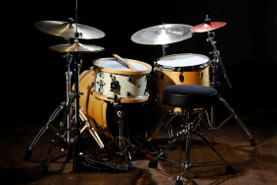
Many inexperienced drummers suffer from ‘Hi-Hat Overload’. This is basically when a drummer has a tendency to smash the living daylights out of a hi-hat while at the same time lightly tickling the kick and snare.
The imbalance in loudness makes for a weak and trashy sound that can’t really be polished in the mix. Your solution here is to switch the hi-hats for a quieter pair. You’d be surprised at the different tones, characteristics and volumes the same drummer can get from different sets of hi-hats.
How to Mix Drums and Avoid Cymbal Overload
 The same problem can often occur with cymbals, especially giant crash cymbals. You have two solutions.
1 – Switch the cymbals like you did with the hats.
2 – If you still have too much volume with the cymbals try moving them away from the drummer slightly so he can’t get a 100% smash of them. Make them high enough that he can reach them but just far enough that he has to ease off the power.
Quiet Kicks & Snares
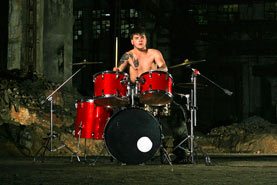 There’s nothing worse than a drummer who gently strokes the drums when he’s supposed to be belting them with full force. By all means there are times when soft hits are essential but lets say your recording a punk or metal band and the drummer is hitting as if he’s playing trad jazz at the local Working Mens Club. Your drums are going to sound weak.
The obvious solution is to get the drummer to hit harder but if he’s not used to that he’ll struggle to maintain his flow if he’s learning how to play all over again. The next best solution is to change the drums to louder drums. This is easier for snare drums than for kick drums.
We used to have a little piccolo snare which sounded great but had very little bottom end and not much volume. We switched it for a ‘Premiere’ marching snare drum which sounded fabulous but was 3 times louder than the rest of the kit. That would have worked perfectly for the gentle drummer.
Bigger Kick drums will often give you a louder sound but they also require more energy to max out their volume. You’ll also want to watch how much dampening you use as too much will weaken the sound and crush the loudness. You need air flow in that kick drum to make the heads resonate and thus give you some punchy volume. Don’t over stuff that kick drum.
Quiet Toms
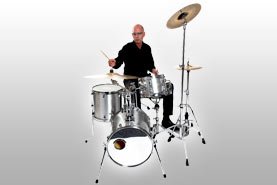 A larger drum does not always mean a louder drum. This is particularly evident with tom toms. It’s more important to tune these correctly in order to get them to resonate at their best. All toms will resonate better when tuned to certain notes.
The trick is in finding this sweet spot but also getting it to work with your other toms. For example, if you’re trying to get each tom to be a semi-tone apart in pitch, you may have to compromise the sweet spot for loudness in order for them to work together in pitch.
In an ideal world your toms should be perfectly tunable so that they are a semi tone apart at each drums sweet spot. High end kits should allow you to do this but occasionally you’ll find a cheap old kit that sounds spectacular – when you do, buy it.
The Silicon Beats studio kit is a beautiful Mapex Birch session kit but the high tom has a sweet spot that has no relation to the other toms so we often only use it sparingly during fills or it will take over the mix.
Heavy Metal drummers often tune their toms so that the skins are very slack in order to get a punchy ‘click’ sound to their toms. This can sound great but almost always results in a reduction of loudness. Compare that to the high and mid toms of a traditional jazz drum kit and you’ll find the jazz toms are way louder.
Get the best gear you can afford
It sounds obvious but it can often be overlooked. When most music stores are prepared to rent out high quality equipment, there really is no excuse. Get the best mics you can afford and play around with them. New mics are coming out all the time so you may even discover a rival for the good old SM57. If you do let us know.
Get the best Mic Pre-amps if you like but these are not essential. Use high quality cable and if you are using a snake cable don’t cheap out, get the best you can afford so as to avoid noise.
How to Mix Drums and Use The Room
We realize we’ve banged on about the importance of your room ambience in our article ‘How to Record Drums‘ but having a massive live room is not mandatory. You’d be surprised how huge your medium sized room will sound once you’ve added some tasty compression to your drums.
When considering how to mix drums, there’s something to be said for the totally dry, zero room ambience sound. You’ll find it in many funk recordings (think of the super funky Jamiroquai drum sound). Work with what you’ve got, if it sounds terrible pick another location. Don’t be concerned about furniture and other objects effecting the sound. Sometimes these objects can make your sound much more interesting.
A Quick Room Test
While learning how to mix drums, our suggestion would be to pick a room, use two mics to record a stereo image of your kit placed about 4 ft away from the kit and about 8 ft apart at the drummers head height. Now add some fairly aggressive compression to both channels and listen back to your quick recording on both headphones and speakers.
If it sounds awful go somewhere else. Keep doing this until you find the best place, it might be at the bottom of the staircase, it might be in the kitchen with the garage door open, you won’t know until you try.
Be sure to use the exact same micing technique in each room so that you can compare how each room affects your recording. You’ll be amazed at the difference.
Double Check your Playback – Assume the worst
We’ve all cursed ourselves for not paying enough attention during a recording session. We later find that one of the mic cables was faulty and started buzzing all the way through the penultimate drum solo of our best song. Too late, the band packed up and left the building. Now you’re stuck with a totally unusable drum track because you didn’t pay enough attention to your playback.
When recording drums, always assume that something will go wrong. Solo and check each track as a matter of routine. Drum kits will move while they are being played, what seemed like the perfect snare mic position 3 hrs ago might now be a total disaster with your newest SM57 rubbing on the snare head every time the drummer gives it a whack. We’ve seen this a few times.
Gear also fails, mics don’t last forever (although SM57’s pretty much do), cables sometimes get ruined and improperly fastened mic stands eventually succumb to gravity.
How to Mix Drums – Summary
So, you’ve done everything right. You’ve got the best drum kit in the world, you’ve got a top class drummer playing in the best live room you can find. All of your recording equipment is as good as it’ll ever get and you’re now laying down pristine quality drum tracks with a happy drummer and a great sounding drum kit.
Your almost half way there.
How to Mix Drums Part 2 of this article focuses on how to process and mix your multitrack drum recordings to get them sounding clean and professional.
Great and useful article. Concerning the gentle hitting of the drums in studio. I also had this problem when I was first time in studio and I was used to hit drums quite gente because of a small practice room and clubs we had gigs in. What worked for me is switching the drumsticks. I used to play 7Ds but when I switched to some heavy 2As we had no problem anymore. It was hard for me to get used to these larger sticks, but the difference was really worth it.